

The Work Behind a Flower Farm

My alarm goes off long before the morning light even comes.
That's the first thing most people don't know about a flower farm. The day starts in the dark, not because it has to, but because dawn is when the field is most itself. Cool air, dew still on the stems, no wind yet. The flowers haven't been touched by the heat of the sun yet. There's a particular kind of quiet out in the field before the sun rises that I've never found anywhere else. And after all this time, I still look forward to witnessing the sun rise and the fields slowly gain color.
But this is what life on our flower farm actually looks like:
Planting
Everything begins in fall, depending on what we're growing. Bulbs, seedlings and seeds that need the cold go in the ground in October, when the soil is still workable but the temperatures have dropped and the light has changed - plants like Tulips, Larkspur, Phlox and Poppies. Each one placed by hand at the right depth, the right spacing, in rows that will make sense come spring. All our flowers are field grown and so we have the added responsibilities of managing row cover, deer fencing and frost cloth.
While things do slow down quite a bit in fall and winter, they never stop and “taking winter off” is not a thing in a real working flower farm. During November and December the fields are all planted for spring and tucked in for winter. We spend time learning, planning and ordering our summer crop seeds and plugs. The week after Christmas we sow hundreds of lisianthus seeds and also start our perennials. I absolutely love propagation and spending time in the grow room. Watching thousands of plants spring to life - often right before your eyes - is so peaceful.
Spring planting follows in March and April. Seedlings started in the grow room weeks earlier are moved out to the field once the frost risk settles. There's always a window of uncertainty there, a stretch of nights where you watch the forecast and make your best call. Some days everything is fine. And some days you cover everything with frost cloth at ten o'clock at night only to pull it off again at seven the next morning.
My daughter Kat joined me in planting last fall. What would have taken me weeks to finish only took a matter of days with her around. There’s just something about having another person around that eases the slow and repetitive nature of planting, and makes the work just fly by. And it doesn’t even feel like work. It feels like fun.
Propagation
Some of what we grow starts from seed. Others from cuttings or division. Propagation happens mostly in our grow room in late winter, when the field is still frozen and the work moves indoors. Trays of seedlings under grow lights, misting schedules, the particular smell of damp soil and warmth in a cold month.
It's patient work. Some of what you start won't make it to the field. You account for that and you start more than you need but always feel that bit of joy when the first seedlings sprout. Propagation is really my favorite aspect of flower farming.
Maintenance
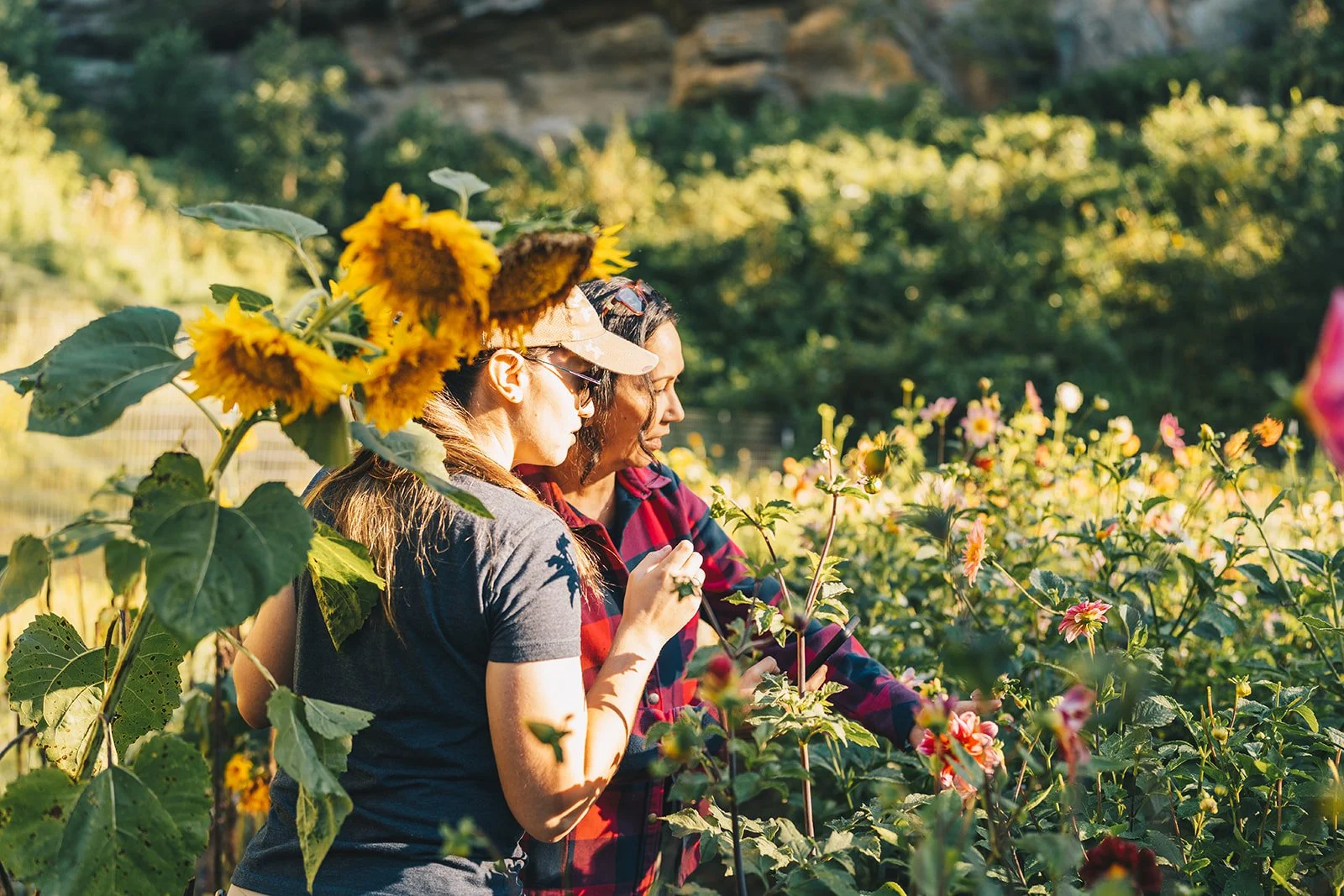
Once things are in the ground and growing, the work shifts to tending. Weeding, which is constant. Irrigation, which requires attention in dry stretches. Pest and disease management, which means walking the rows regularly and noticing things early before they become problems. Thrips, aphids, pill bugs and many more pests love our flowers as much as we do. We don’t spray pesticides here but if we have to, we will use neem. My preference is actually to feed the soil and optimize the soil health. Bugs are just part of life on a flower farm.
There's a rhythm to maintenance that I've come to appreciate. The same rows, the same checks, day after day. You start to know each section of the field the way you know a room in your own house. You notice when something is off before you can name what it is. Your plants start becoming your people in a strange sort of way, and you’re constantly checking on them to make sure they are happy and healthy.
Evening walks have become part of my daily routine. Even if I spent all day in the field, I still have to do my walk at the end of the day, just to check on everyone.
Summer
When midsummer arrives, the field transforms entirely. The gaps between rows vanish as everything pushes outward with sudden energy. The zinnias reach up to my shoulders now, and the dahlias are opening their heavy heads faster than our shears can keep pace. It’s a constant overlap—new successions being tucked into the earth even as the earlier plantings demand a daily harvest.
This is the season when the farm is at its most vibrant, but it’s also when the work is almost relentless. The heat settles in early and refuses to leave, keeping us out in the rows for late-day watering. We are constantly deadheading, a repetitive but necessary rhythm to ensure the blooms keep coming. Some mornings, the abundance feels impossible to manage. Other times, you walk out in the early light to find a row was flattened by a sudden storm or discovered by the deer overnight. It’s a delicate balance of beauty and risk. On top of that, we are already deep into planning for the next year and placing massive orders for fall planting, trialing new varieties and color palettes, determining themes and trends.
Despite the long days, this is the version of the farm people hold in their minds. There are buckets at every turn and the familiar sting of scratches on your arms from reaching deep into the rows. You watch the bees move lazily through the rows, and you realize the field has finally become exactly what it was always meant to be.
Harvest
Harvest is the part people imagine when they think of a flower farm, and it is as good as it looks, but it's also precise and time-sensitive work. Every flower has a window. Cut too early and it won't open. Cut too late and you've already missed it.
We cut in the early morning, and place our stems into buckets of water immediately. The field is quiet at that hour. The only sounds are the shears, the birds, and my daughter talking to the sleepy bees nesting in a flower. I have done this hundreds of times and it has never become ordinary.
Post-Harvest
This is the part that happens out of sight. After cutting, stems are processed, re-cut at an angle, stripped of lower leaves, and moved into the cooler. Temperature and hydration matter more here than most people realize. A flower that isn't handled well after harvest won't perform the way it should in the vase, regardless of how well it was grown.
The cooler is its own dark and quiet world. Rows of buckets, cold air, the particular stillness of flowers waiting and the incredible smell of thousands of flowers surrounding you.
What the work adds up to
By the time a stem reaches someone's hands, it has been tended for weeks, months, or maybe even years if it’s a perennial. Planted in uncertain weather, grown through whatever the season brought, cut at exactly the right moment, and handled carefully from field to cooler to wherever it's going next.
I don't say this to make the work sound more than it is. I say it because I think it's worth knowing. There's a season inside every flower, and it was grown by someone who got up before the sun did.
