

Flower Focus: Peonies
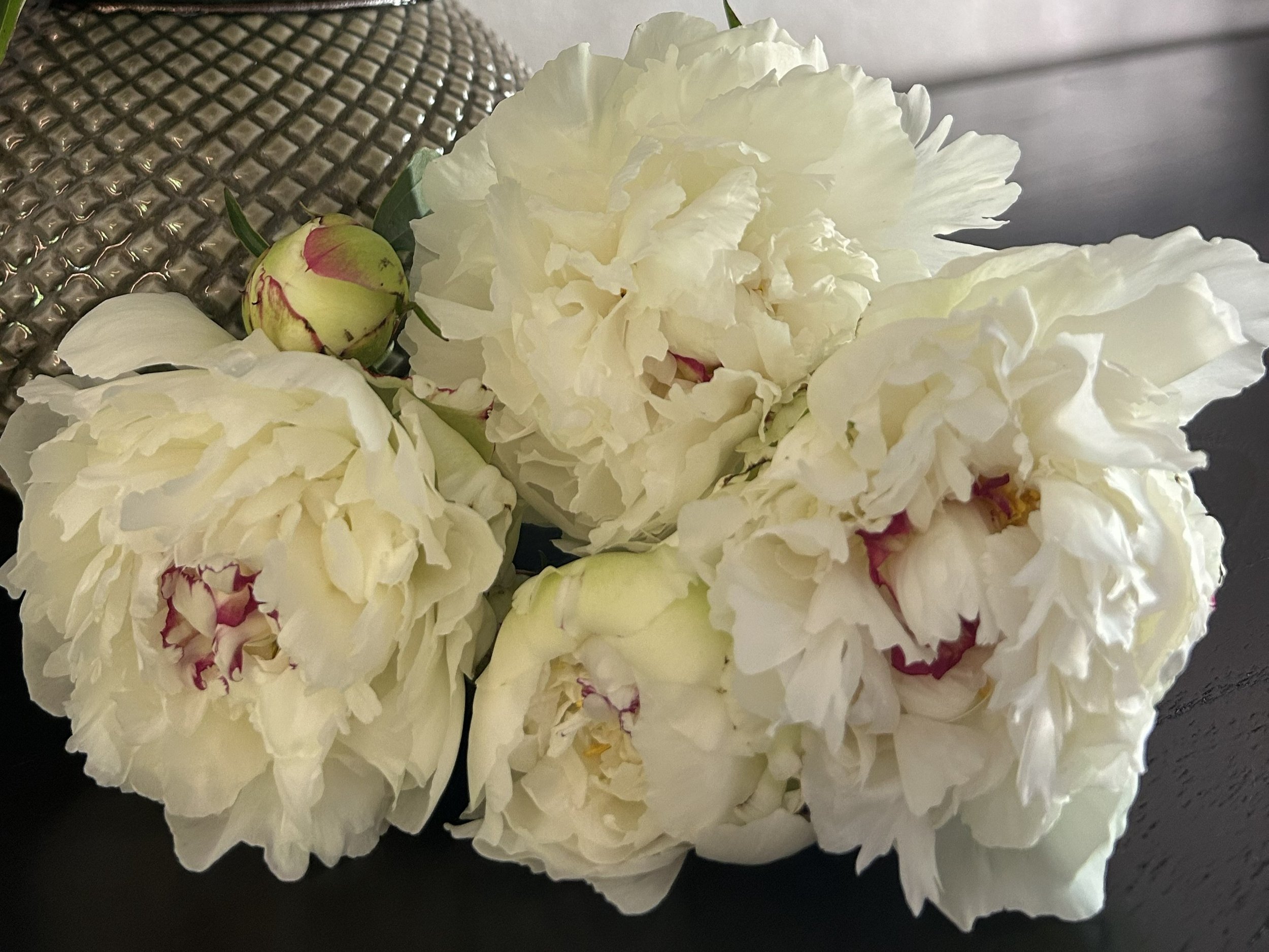
There's a moment in late May and early June when the peony buds finally loosen and the petals begin to push open. And no matter how many seasons I've watched it happen, it still takes my breath away. Peonies are one of the most beloved (and most layered) flowers we grow at BloomSky Flower Farm. They are not at all subtle and their vibrance makes them worth paying attention to.
If it’s not yet obvious, this month's Flower Focus is on peonies: what they mean, the different types, why they belong in your bouquet, how we grow and harvest them on the farm, and how to take care of them once they're home with you.
Peony History
Peonies have been cultivated for thousands of years. In China, they were first grown as a medicinal herb. In the imperial gardens, they carried associations with honor and prosperity. In the West, peonies symbolize romance, good fortune, and happy marriage, which is a large part of why they've become one of the most requested flowers for weddings, graduations, and celebrations of all kinds. In The Secret Language of Flowers in the Victorian Era, peonies represented beauty, prosperity, and things not immediately revealed.
Beyond symbolism, peonies have simply been loved for a long time. They appear in Dutch Golden Age paintings, in Japanese woodblock prints, in cottage gardens across England and the American Midwest. Peonies are not only undeniably pretty, but they carry a lot of history in their petals.
Types of Peonies
Not all peonies are the same, and the differences are worth knowing if you're choosing flowers for an event or an arrangement.
Single
Single peonies have one or two rows of petals surrounding a vibrant center of stamens. They're the most open among all the types. They’re lighter in form with a simplicity that works well when you want the flower to feel airy rather than full. They tend to be beloved by pollinators too.
Semi-Double
Semi-double peonies have multiple rows of petals but still show some of the center. They have a looseness to them that feels natural and unstructured. They look less formal than a double and more layered than a single. They photograph beautifully and work across a wide range of arrangements. They have this open tousled look that softens an arrangement immediately .
Double
Double peonies are dense, full, and heavily layered. This is what most people picture when they think of peonies. The petals grow inward and the center is completely hidden. They can carry a bouquet on their own and are the type we most often include in arrangements when someone wants something that reads as abundant and lush. They're also the most fragrant, which becomes very apparent once they're inside a room.
Itoh (Intersectional)
Itoh peonies are a hybrid. They’re a cross between herbaceous and tree peonies. They were developed in the mid-twentieth century by a Japanese horticulturalist named Toichi Itoh, and they carry characteristics of both parents: the strong stems and large blooms of tree peonies and the die-back habit of herbaceous ones. They tend to bloom longer than the others and hold their color well. In the field, they're sturdy and a little quieter than the showier doubles, but in an arrangement they manage to pop out and offer something that lasts.
Why Peonies Belong in Your Bouquet
Part of it is the obvious thing. They're beautiful and people respond to them immediately. But there's more to it than just face value.
Peonies, when picked at the right stage, will continue to bloom for days in the vase. This means that the bouquet you bring home on Saturday will look different by Tuesday, and different again by Thursday. You get the full arc of the flower rather than a single frozen moment of it.
They also serve as the heart of arrangements. One or two peonies in a mixed bouquet give it weight and focal point without needing much else. For events like weddings, graduation parties, and anniversary dinners, they read as intentional without requiring an elaborate design around them.
Lastly, we have to talk about the fragrance. A double peony in a warm room fills the space. It's one of the more distinctive scents in the flower world. Sweet but not heavy and it tends to bring people into the room rather than push them out of it.
How We Grow and Harvest Peonies at BloomSky Farm
Peonies are slow. We plant them as bare root divisions every fall, and in the first year we don't harvest flowers from them at all - we actually remove all the buds. The plant needs as much time as possible to establish itself and build energy for future seasons. Because of that, full production doesn't come until the third year. In a way, growing peonies is a practice in patience, and certainly well worth the wait.
We harvest peonies in what growers call the marshmallow stage, when the bud is soft, beginning to show color, but hasn't yet opened. At that stage the stems are strong and the flower has everything it needs to open fully at home. Cut too early and the bud won't open. Cut too late and the best of it has already passed. Timing is everything. Even the time of day matters when harvesting flowers.
After cutting, we cool the stems quickly and keep them hydrated. When we're not using them immediately, we store them in the cooler where they'll hold for up to a week, still closed, still waiting. Larger farms will cut and dry store peonies for weeks in the cooler, but as a small farm, we use them almost always in the same week we cut them.
How to Take Care of Peonies at Home
Once you take your peonies home, a little attention goes a long way toward extending their vase life.
Trim the stems at an angle before placing them in water. Repeat this every couple of days.
Use a clean vase as bacteria shortens vase life more than almost anything else.
Keep them away from direct sun and heat sources. These speed up opening and shorten the display.
Change the water every two days.
If your buds are slow to open, move them to a slightly warmer spot.
Remove any leaves that fall below the waterline to keep the water clean.
As outer petals begin to drop, remove them carefully. What's left underneath is often still beautiful and worth keeping.
Peonies are with us briefly every spring, but they give a lot in the time they're here. That's the trade off, and we find it more than fair.
