

A Story About Curtain the Owl
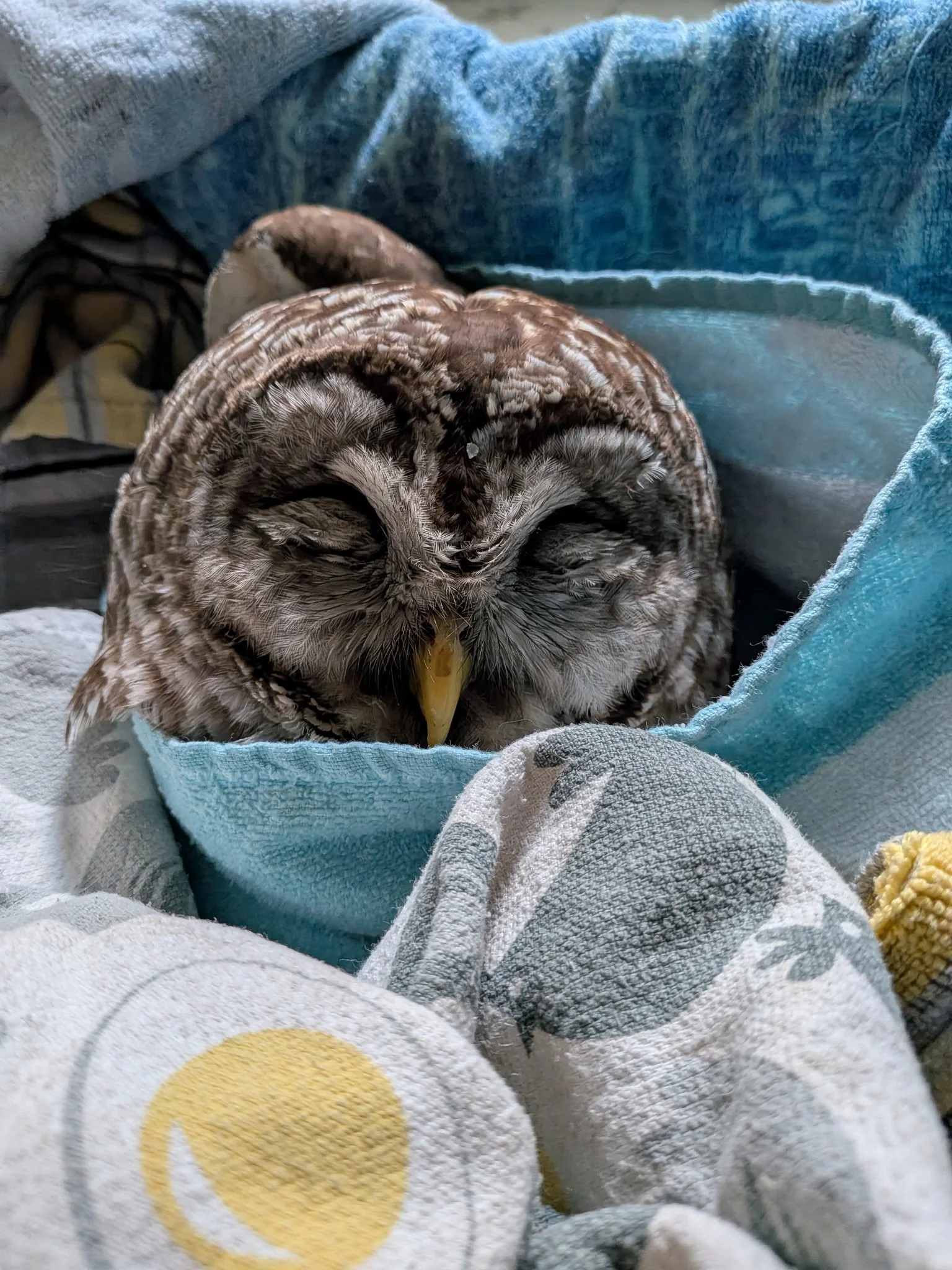
A little over a month ago, I shared a couple quick stories about an owl that I rescued. I didn’t post about it when I first encountered it, but now, you’ll get the full story.
It was dusk and I was driving back to the farm when I saw something on the over by Turkey Ridge Lodges. Something about the shape of it, low and still against the asphalt, made me slow down. Turns out, it was an owl and it looked like it was laying exactly where it had landed after being struck by a car.
Owls have some of the poorest peripheral vision among birds, despite their reputation as exceptional hunters. Because their eyes face forward, owls have less peripheral vision than many birds. If an owl is focused on prey along a roadside, an approaching vehicle may not be quickly detected. That's clearly what happened to poor Curtain, who was just hunting for its dinner.
I approached carefully and slowly. It didn't appear to have any broken bones, but it did have serious head trauma and while I'm a natural optimist, I was not hopeful it would survive the night. But there was no way I was just going to leave it to die. I carefully gathered it up, taking special care to avoid the talons and beak, and drove home with an owl in my lap, which Tim didn't take nearly as calmly as I did.
Kat, however, went into medic mode and before I knew it, we had the owl gently bundled in towels in a hamper in the bathtub. It was completely unconscious but breathing and I knew that the best we could offer was quiet and darkness, so we closed the shower curtain, hit the lights and closed the door. Kat being Kat named it Curtain - completely unsurprising if you know her.
Then Curtain stayed with us through the night.
What Happens After You Find an Injured Bird
The most important thing you can do for an injured wild bird is keep it warm, keep it dark, and keep it calm. Do not give it food or water, and don't handle it beyond what's absolutely necessary, no handling beyond what's necessary. The instinct to help more can actually cause more harm. The second most important thing is to get it to a licensed wildlife rehabilitator as quickly as you can.
Since we have a partnership with a wild bird researcher, Anne, she was the first call I made, and I am so grateful she was able to rush Curtain to the Ohio Wildlife Center in Columbus where it could be properly evaluated and cared for. Rehabilitation centers have the training, equipment, and permits to give injured wildlife the best chance at recovery. A well-meaning household, however warm and willing, is not a substitute for that.
Ohio Wildlife Center, one of the largest wildlife rehabilitation organizations in the state, has been helping injured, orphaned, and ill native wildlife for over 40 years. Organizations like these depend heavily on community members who stop, who notice, and who make the call.
Three Weeks Later
The rehabilitation center called about three weeks after Curtain was dropped off. Miraculously, it had survived and was recovered well enough to be released, and they wanted to return him to the area where he was found—which is standard practice for raptor releases. Something I didn't know was that the release site matters. Owls are territorial and habitat-specific, and returning them to familiar ground gives them the best chance of reestablishing themselves.
Anne brought Curtain back to the hills and on June 5 we watched as it was released.
Videos show a raptor release being stirring and fast, but Curtain took his sweet time. We had a few hilarious moments where he sat looking at us and we stood back watching him. At one point we made the intelligent decision to take the top off the crate and after that, things moved much more quickly. Curtain began looking around, and with a powerful swoop of his wings, was gone, back into the tree line and into the dark edge of the woods where dusk had already settled.
And then he was gone, back into the tree line, into the dark edge of the woods where dusk had already settled.
Hocking Hills is home to barn owls and barred owls among other species, and the forests and field edges out here are exactly the habitat they need. Seeing one go back into that landscape felt wonderful.
Why This Matters
Wildlife rescue isn't something most people plan for. It happens at dusk on an ordinary drive home.
The birds and animals that share this land with us don't have much recourse when they're hit, displaced, or injured by the infrastructure of human life. Roads cut through habitat and cars move faster than animals can process. What we can do, when we happen to be in the right place, is stop and see if we can render assistance. It may just be helping that box turtle cross the road (but don't take it home!), scoot a snake out of harm's way, or gather an injured owl to bring to the rescue center.
I hope Curtain is thriving in the woods here around the flower farm. I love that we can be stewards in our small way of the creatures who call Hocking Hills home and encourage everyone to try, however they can, to also protect, support and care for our beautiful home.
